
Lowndes County Court Records After Arrest
A Lowndes County arrest usually starts as a custody event at the jail, but the court record forms when a judge, clerk, prosecutor, or court system creates and updates the criminal case. The jail record may show an arresting agency and booking charge, while the court record may later show a complaint, accusation, indictment, amended charge, dismissal, plea, conviction, or other disposition. Those two records can use different wording.
The District Attorney handles felony prosecution for Lowndes County. Official county directory details identify District Attorney Bradfield M. Shealy, with a physical office at 327 N. Ashley St., Valdosta, GA 31601, phone 229-671-3268, and fax 229-245-5281. The DA reviews evidence and decides what formal charges to pursue. For custody and booking detail, use Lowndes County jail inmate records; for booking-photo access, use Lowndes County jail mugshots.
Find Court Records After Arrest
The main official sources are the Lowndes County Clerk of Court, the county courts hub, Magistrate Court for warrants and first-stage criminal matters, the District Attorney, and the Georgia court records search. The Tyler portal is a statewide search tool, but county and court availability can vary by record type.
- Start with the jail record or custody call to get the person's name, arrest date, booking charge, and any case number if available.
- Search the court portal by party name or case number, using Lowndes County or the correct court location when the portal offers that filter.
- Open the case result and compare the filed charges against the booking charge from the jail record.
- Read the status and disposition for each charge because pending, dismissed, reduced, amended, and convicted mean different things.
- For older or unavailable records, contact the Clerk of Court or the court that handled the case.
The manifest includes the Georgia court-search screen used for this route: Georgia court records search homepage.
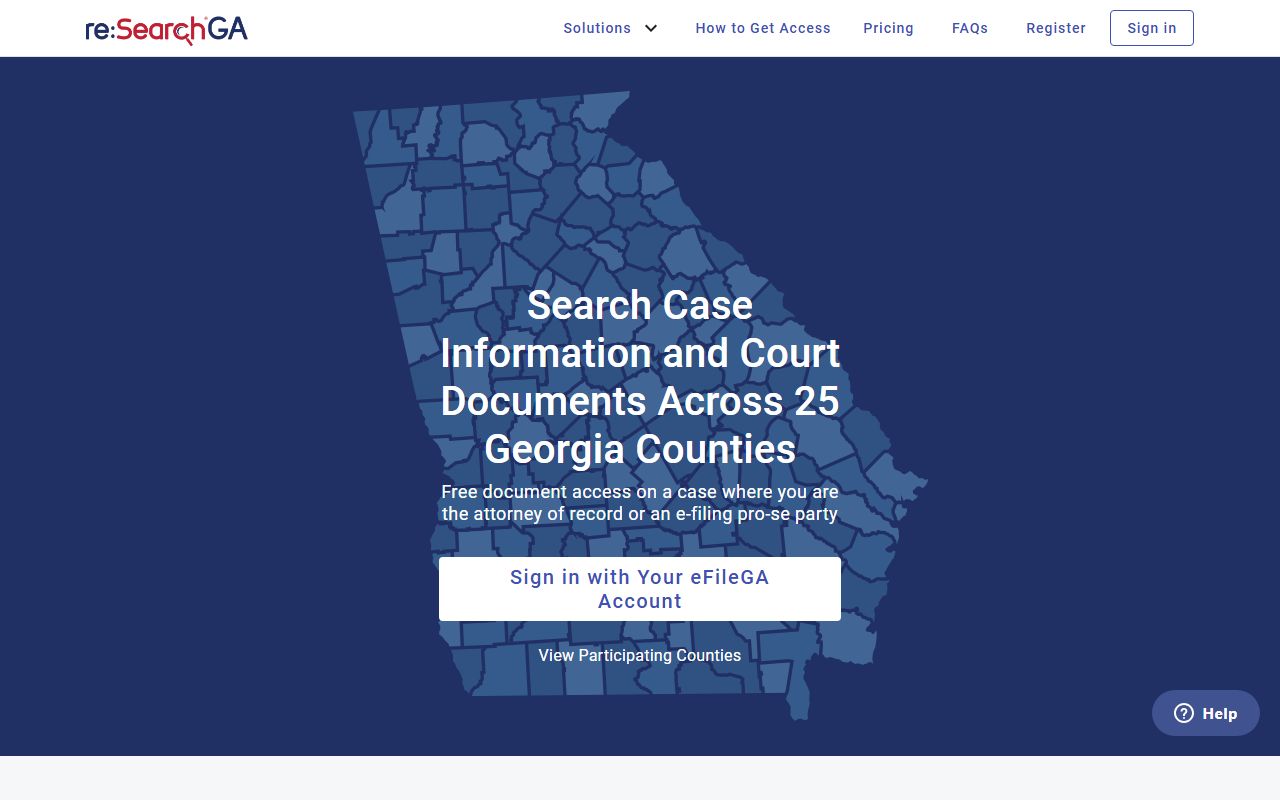
The screenshot belongs with the court-record search path because it is the official statewide portal identified in the research for filed case records.
Lowndes Court Search Fields
The Georgia/Tyler portal supports several search modes. It may allow search by case, party, attorney, judicial officer, or business. When a Lowndes County filter or court-location choice is available, use it to avoid mixing similarly named defendants from other counties. A date range can help match the filing to the arrest date.
| Field Label | Type | Required | Options / Format Notes |
|---|---|---|---|
| Search by Case | Tab or search mode | No | Best when the case number is known |
| Search by Party | Tab or search mode | No | Use defendant first and last name |
| Attorney / Judicial Officer / Business | Search modes | No | Availability depends on portal configuration |
| County / court location | Dropdown or filter | Workflow dependent | Choose Lowndes County or the relevant court when available |
| Date range | Date fields | Optional | Narrows filings and hearings |
Arrest to Court Timeline
The court records after a jail arrest timeline runs through several stages. First comes arrest and booking at Lowndes County Jail. Then an early review or first appearance may occur through Magistrate Court or another court with jurisdiction. Next, the prosecutor reviews the facts and decides whether to file, amend, reduce, dismiss, or pursue different charges.
The booking charge is a starting point, not always the final case. A warrant may list one offense, the jail record may repeat that booking language, and the court record may later show a different statutory charge or case status. That is normal in criminal procedure. A careful records check compares the jail entry, the charging document, and the court docket before drawing conclusions.
Custody flow: Arrest leads to booking, then first appearance, prosecutor review, formal filing, court hearings, and disposition or transfer.
Charging Documents After Arrest
Charging documents are where court records after arrest become more formal than a jail roster entry. A complaint, accusation or information, and indictment are not identical. The terms can vary by court and charge type, but the key point is that the filed document controls the court case, not the shorthand text on a booking entry.
| Document | Who Uses It | What It Does |
|---|---|---|
| Complaint | Officer, prosecutor, or court process | Starts or supports a criminal allegation, often early in the case |
| Information / accusation | Prosecutor | Files formal charges without a grand-jury indictment where allowed |
| Indictment | Grand jury | Charges felony offenses after grand-jury action |
Charge Status After Arrest
Charge status is the part of the court record that tells whether the allegation is active, changed, dismissed, or resolved. The same person can have several charges with different statuses. That is why one case may show a dismissal on one count, a plea on another, and a pending hearing on a third.
| Status | Meaning |
|---|---|
| Pending | The case or charge is active and has no final disposition yet |
| Amended | The charge language or count changed after review |
| Reduced | A lesser charge replaced the original charge |
| Dismissed | The court ended that charge without a conviction |
| Nolle prosequi | The prosecutor declined to proceed on that charge |
| Bound over | The case moved from a lower court to a higher court |
Bond Records After Arrest
Bond information may appear in jail, court, or both systems. Lowndes County did not publish a local bond fee table or payment-method page in the official sources inspected. The official path is to verify current bond through the jail at 229-671-3000 or through the relevant court record. A hold from another agency can prevent release even when bond is posted on the Lowndes charge.
| Bond Type | How It Works |
|---|---|
| Cash bond | The full bond amount is paid directly to secure release |
| Surety bond | A licensed bail bonding company guarantees the bond |
| Property bond | Real property secures release where approved |
| Own-recognizance / PR bond | The person is released on a promise to appear |
| No-bond hold | Release is unavailable until a judge or holding agency acts |
Warrants Before Jail Arrest
No standalone official active-warrant search was located in the Lowndes County or sheriff pages inspected. Magistrate Court is the key official source for warrants, first appearances, and criminal affidavits. The sheriff site also lists a Court Division phone number of 229-671-2690, while the jail line is the practical source if the person has already been booked.
A warrant record, where available, may include the defendant name, issuing court, warrant or case number, charge, date issued, bond status, and holding agency. Bench warrants, arrest warrants, search warrants, and fugitive holds are not the same thing. A search warrant authorizes a search of property, while an arrest or bench warrant can lead to jail booking.
Charges vs Convictions
An arrest or filed charge is not a conviction. A charge is an accusation moving through the court process. A conviction follows a guilty plea, guilty verdict, or other final finding that counts as conviction under the law. The difference matters for employment, licensing, housing, personal safety checks, and record restriction.
| Point | Charge | Conviction |
|---|---|---|
| Stage | Allegation or filed count | Final guilty plea, verdict, or qualifying outcome |
| Proof | Probable cause or prosecutor filing standard | Higher criminal proof standard or plea admission |
| Record meaning | Case is alleged, pending, changed, or dismissed | Case resulted in guilt on that charge |
Restricted Court Records After Arrest
Georgia's record restriction law, O.C.G.A. 35-3-37, can limit public criminal-history dissemination after eligible outcomes. It is not a promise that every court page, jail log, third-party copy, or booking photo disappears at once. Eligibility depends on the case result and the statutory process.
| Term | Plain Meaning | Lowndes County Note |
|---|---|---|
| Sealed | Hidden from ordinary public view | Access may remain for courts or law enforcement |
| Record restriction | Georgia process limiting public dissemination | Use official forms and court or agency directions |
| Expunged | Often used casually for cleared records | Georgia commonly uses the term record restriction |
O.C.G.A. 50-18-72 also contains exemptions that can limit law-enforcement records. Juvenile matters, sealed cases, active investigations, and protected personal information may not appear in a public court or jail lookup.